

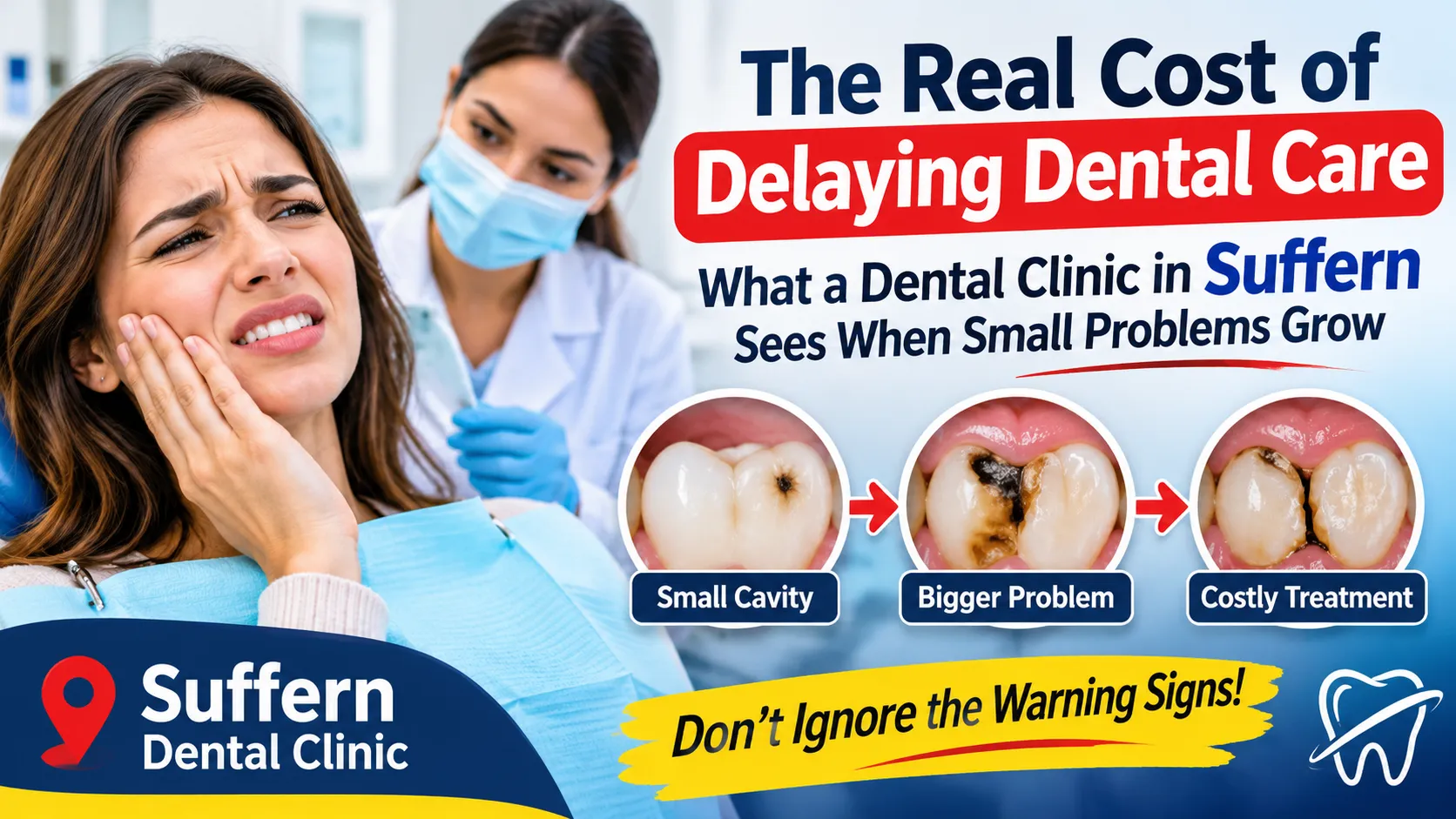
A tooth twinges on cold water. Gums bleed a little during flossing. Neither one hurts enough to stop your day, so you tell yourself you’ll call next month. Next month turns into next season.
It’s a normal thing to do. Most small dental problems don’t hurt much at first, so there’s nothing pushing you to act. At our dental clinic in Suffern, we watch this play out often. A quick fix left for a year usually stops being quick.
So what actually happens when common dental issues sit untreated? Here’s the pattern we see, along with how to get back on track without any guilt about the gap.
Why Small Dental Problems Are So Easy to Put Off
Early decay and early gum disease are quiet by nature. They rarely come with pain, so there’s no obvious reason to rearrange your week around a dentist visit.
If that sounds familiar, you’re not alone. Untreated cavities are common, especially among people juggling jobs, kids, and everything in between. Most of those cavities started as a small spot nobody noticed until it grew into something bigger.
That’s the frustrating part, honestly. The quiet stage is also the easiest one to treat. That’s exactly why dentists keep pushing regular checkups, even for patients who feel fine.
How a Small Cavity Can Turn Into Bigger Treatment
Decay moves from the outside of your tooth inward. Enamel, the hard outer shell, comes first. Underneath sits dentin, a softer layer, and below that is the pulp, home to the tooth’s nerve and blood supply.
Catch a cavity at the enamel stage and it’s usually simple to treat with a small, tooth-colored filling. Sometimes fluoride and better brushing alone are enough.
Give it more time, and decay spreads faster once it reaches the softer dentin underneath. The filling grows larger. Sensitivity to cold drinks or sweets tends to show up around here too.
Wait longer, and bacteria can reach the pulp, where a filling usually won’t cut it anymore. At this stage your dentist may recommend root canal therapy, often paired with a crown. Push past that and a weakened tooth can crack or develop an abscess. Extraction and tooth replacement may end up on the table.
Each of those steps adds appointments. A filling is one short visit. A root canal and crown usually take several, and an implant can stretch across months.
Not every tooth moves through these stages at the same speed. Your dentist will look at your actual X-rays before recommending anything.
How Early Gum Disease Can Quietly Progress
Gum disease has its own quiet stage. It starts as gingivitis, which shows up as gums that look red or swollen, or bleed a little during flossing.
Good news here: gingivitis usually responds well to better brushing, daily flossing, and a professional cleaning or two. It’s genuinely reversible at this point.
Left alone, though, it can advance into periodontitis. That stage affects the bone and tissue holding your teeth in place. It shows up in adults more often than people expect.
Treatment can manage periodontitis and slow it down, but it can’t rebuild bone that’s already gone. That little bit of blood on the floss isn’t nothing. Worth mentioning at your next cleaning, while it’s still one of the easiest things to fix.
What Delayed Care Can Cost Beyond the Dental Chair
Waiting doesn’t just mean a bigger bill down the road. Sometimes it means ending up somewhere you never planned on: the emergency room.
A lot of people head to an ER once dental pain gets bad enough. ERs can numb pain or knock out an infection for a while. They’re not built to actually fix a tooth, though. You’ll still need a dentist afterward, so that trip buys time more than it buys a real fix.
There are quieter costs too, the kind that don’t show up on a bill. More extensive treatment usually means more time away from work, or a kid missing school for an appointment. Expect more numbing and a longer recovery than a simple filling would need.
There’s a broader health picture here as well. Some research has looked at a possible link between gum disease and heart disease. It found an association between the two, though that’s not proof one causes the other. Researchers are careful to say so.
Even without that link, your gums are worth caring for on their own.
What Our Dental Clinic in Suffern Looks For at a Routine Visit
A routine exam exists to catch exactly this kind of problem while it’s still small. Six months between checkups works well for many patients. Your own dentist might suggest something different, based on your history.
A typical visit at Promise Family Dental usually includes a cleaning and X-rays when they’d help spot hidden decay. A gum check and cancer screening round it out. We walk you through whatever we find in plain language. Nothing gets decided without that conversation happening first.
The goal is simple: catch small issues while they’re still small. Our general dentistry services cover preventive and restorative care for every age in the family.
Getting Back on Track After a Long Gap
Maybe your last cleaning was three years ago. Maybe longer, and you’ve genuinely lost count. Either way, that’s fine.
Plenty of patients from Suffern, Airmont, Monsey, and Spring Valley walk back in after a gap like that. Nobody here is going to make you feel bad about it.
Picture a parent who put off appointments for years while juggling a full household. They finally book one because a tooth has started aching.
The exam might show that tooth needs a root canal. It might also turn up two smaller cavities nobody felt yet. Simple to fix now, bigger problems if they wait.
If the whole idea of a visit makes you anxious, just say so when you book. We’ll walk through each step before doing anything, and sedation options are available if you want them. Saturday appointments help too, for anyone whose real obstacle is a weekday schedule.
Taking the Next Step With a Dental Clinic in Suffern
Small dental problems are the cheap, simple ones to treat. They won’t fix themselves by waiting, but they don’t have to turn into anything bigger either. A routine visit is just a chance to see where things actually stand. From there, you decide your next move.
At Promise Family Dental, children, adults, and seniors are all cared for under one roof. Your whole family can stick with one team as everyone’s needs change. Our hygienist Cheryl Schwack-Biondi brings more than 30 years of clinical experience to every cleaning. Clear answers and your comfort come first.
Schedule your visit with our Suffern dental office before a small problem gets the chance to grow.
Frequently Asked Questions
Q: How long can you wait to fill a cavity?
There’s no single safe number here, since cavities don’t all grow at the same rate. Some stay small for months, while others reach the nerve much faster than you’d expect. Small cavities are the easiest ones to fill, so it’s worth treating them soon after diagnosis. Your dentist can tell you how urgent your specific case is.
Q: Can gum disease be reversed?
Better brushing, flossing, and professional cleanings can often reverse gingivitis, the early stage. Periodontitis, the more advanced stage, can’t be fully undone once it sets in. Treatment and consistent home care can manage it and slow it down. That gap is exactly why early checkups matter so much for your gums.
Q: What should I expect if I haven’t seen a dentist in years?
Your first visit back to a dental clinic in Suffern usually starts simple. An exam, some X-rays, and a cleaning.
From there, your dentist walks you through what they found and what’s most urgent. Bigger needs often get spread across a few visits. A good dental team won’t judge you for the time that’s passed.