

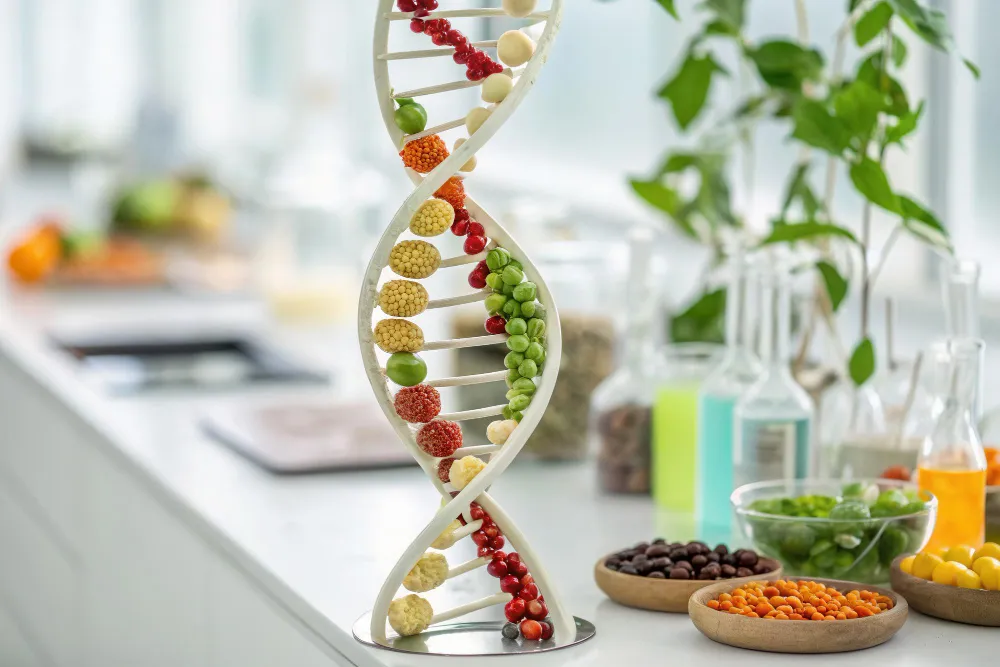
Food has always been personal, but not in the way we once thought. We speak of preferences, cultures, and habits, but beneath all of that lies something far more intimate, our genes.
Two people can eat the same meal and experience it differently. One thrives, the other feels sluggish. One sees improvement in health markers, while the other notices little change. For years, this was often considered coincidence or simple lifestyle variation. Nutrigenomics offers a different explanation.
It suggests that the relationship between food and the body is written, at least in part, in our DNA. When we begin to understand this connection, nutrition shifts from general advice to something deeply individual.
What Nutrigenomics Really Means
At its core, nutrigenomics studies how genes and nutrients interact. It explores how what we eat influences gene expression and how our genetic makeup affects the way we process food. It is not about creating a perfect diet for everyone. It is about recognizing that no single diet works for all.
Instead, nutrigenomics explores why different people respond differently to the same diet, why certain nutrients benefit some individuals more than others, and how dietary choices can influence long term health at a genetic level. The answers are found not only in the food itself, but in the body receiving it.
A Growing Presence in Modern Health Thinking
As interest in personalized health increases, nutrigenomics is moving from specialized research into broader awareness. What once seemed theoretical is now becoming part of practical health discussions.
I recently came across a report by Roots Analysis that really put things into perspective. According to them, the global nutrigenomics market, valued at USD 0.92 billion in 2025, is projected to reach USD 1.04 billion in 2026 and USD 3.07 billion by 2035, with a 12.8% CAGR during the forecast period 2026 to 2035.
Moving Beyond One Size Fits All Nutrition
Traditional nutrition has long relied on general guidelines such as balanced diets, recommended intake levels, and broad categories of healthy and unhealthy foods.
However, human biology is not uniform. Nutrigenomics challenges the idea that everyone should eat the same way. It introduces personalized nutrition, where dietary choices are guided by individual genetic insights.
This shift may appear subtle, but it changes the entire perspective. Instead of asking what is healthy, the question becomes what is healthy for me.
How Food Interacts with Genes
The relationship between food and genes is dynamic rather than fixed. Certain nutrients can activate or suppress specific genes, influence metabolic pathways, and affect how the body stores or uses energy.
For example, some individuals may process fats efficiently, while others are more sensitive to them. Some may require higher levels of certain vitamins due to genetic differences. In this way, food becomes more than fuel. It becomes a signal that continuously interacts with the body’s internal system.
Real World Applications
Although science continues to develop, nutrigenomics is already influencing practical health approaches.
Genetic testing can help guide personalized diet plans, allowing individuals to tailor their nutrition based on their unique biological makeup. Understanding genetic predispositions can support the prevention of chronic diseases such as diabetes or cardiovascular conditions. Athletes and health focused individuals use these insights to optimize energy, recovery, and performance. Weight management strategies can also become more effective when aligned with how an individual’s body processes different nutrients.
Each of these applications reflects a broader shift, where nutrition is no longer just about what we eat, but how our bodies interpret it.
The Subtle Complexity Behind It
Despite its promise, nutrigenomics is not a simple formula. Genetic influence represents only one aspect of overall health. Lifestyle, environment, and daily habits continue to play significant roles. Research is still evolving, and interpretations may vary.
Nutrigenomics does not replace traditional nutrition. Instead, it refines it by adding a deeper layer of understanding.
A Different Relationship with Food
Perhaps the most meaningful change brought by nutrigenomics is not purely scientific, but conceptual. Food is no longer only about taste, tradition, or general health. It becomes a form of communication between what we consume and who we are at a biological level.
This encourages a more thoughtful approach. Instead of simply asking what should I eat, the question becomes what does my body need.
Final Thoughts
Nutrigenomics does not promise perfection, nor does it claim to solve every health challenge. However, it offers something essential, context. It reminds us that our bodies are not identical systems following the same instructions. Each one is shaped by genetics, environment, and experience.
Within that uniqueness lies a new perspective on nutrition, not as a universal set of rules, but as a personalized dialogue between food and life itself.